

Search returns advice, not urgency.
Generic answers do not tell an owner how soon to act for this pet and this change in symptoms.
MVP Pet wellness
Help pet owners organize symptoms, understand source-linked possible explanations and urgency cues, and find a considered next step—without presenting AI output as a diagnosis.
THE OPPORTUNITY
When a pet’s symptoms change, owners often search across blogs, forums, and generic advice. The next step depends on the animal’s species, breed, age, health history, and how the symptoms are changing—not just a single keyword.
Piccolina combines that context with retrieved veterinary guidance and clear escalation cues. Its role is informational wellness support: it can present possible explanations and practical next steps, but it does not diagnose pets or replace a veterinarian.
Generic answers do not tell an owner how soon to act for this pet and this change in symptoms.
Species, breed, age, health history, photos, and how symptoms evolve all shape what the next step should be.
Wellness guidance has to stay clearly separate from diagnosis and from emergency veterinary care.
Initial buyer hypothesis. Pet owners seeking a first, structured wellness check, and the clinics and pet-services businesses that want to engage them earlier. For clinic tooling, the economic buyer is the practice operator.
Piccolina provides informational wellness guidance only—not a veterinary diagnosis or a substitute for care from a licensed veterinarian. Seek urgent veterinary care for emergencies.
THE PRODUCT
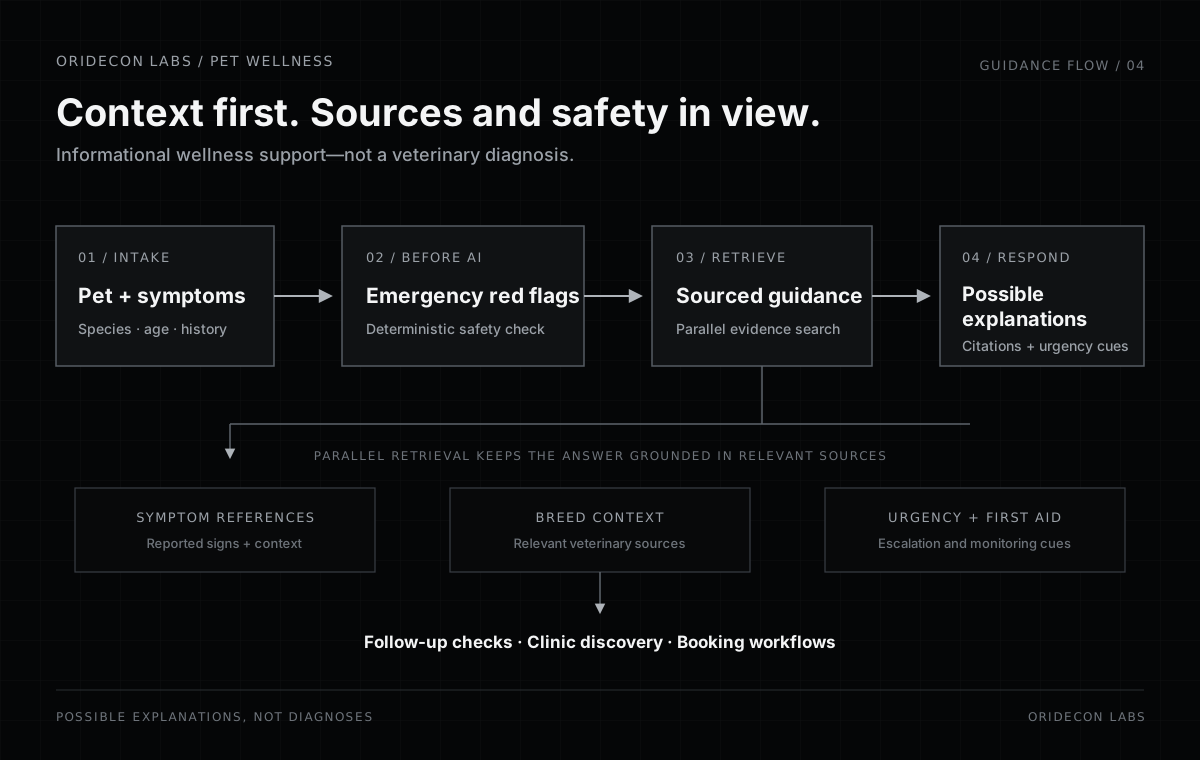
Piccolina combines pet context with cited veterinary guidance: a deterministic emergency check runs first, then parallel retrieval and a schema-validated response present possible explanations, urgency cues, monitoring steps, and follow-up support.
The intake path checks configured emergency signs before model analysis, so an urgent cue is not left solely to a generated response.
Species, breed, age, health history, symptom reports, and supported photos can inform the wellness check and its targeted follow-up questions.
Parallel retrieval brings together symptom, breed, and urgency/first-aid guidance. The response is schema-validated into ranked possible explanations, care guidance, urgency cues, and cited sources.
Follow-up checks reuse the prior analysis thread to assess reported changes. The product includes clinic discovery and a booking-flow prototype; live availability, confirmed appointments, and partner integrations are not yet implemented.
PRODUCT SURFACE
Explore the wellness intake, triage, care plan, follow-up, and booking prototype. Open any image to browse the full set of 16 captured product screens in the lightbox.
EVIDENCE & ROADMAP
Subscription, clinic SaaS, telehealth, referral, and commerce items are planned. No diagnosis, veterinary outcome, adoption, revenue, or clinic-count claim is made.
Informational guidance, not a clinical service. Piccolina is an internal product in active development. No clinic partnerships, veterinary outcomes, or revenue are claimed.
COMMERCIAL THESIS
The thesis connects an initial question to cited guidance, follow-up context, and appropriate local care discovery. Potential business lines are planned and are not treated as current revenue or launched services.
Pair pet-specific context and retrieved references with an emergency red-flag check, possible explanations, and clear escalation language.
Longitudinal pet records, clinic profiles, live availability, confirmed booking, and community services can extend the current prototype over time.
Planned directions include per-pet wellness plans, clinic software, telehealth, diagnostics and insurance referrals, and preventive-care commerce.
| Category | Typical strength | What it leaves open |
|---|---|---|
| Search and forums | Instant, broad access to anecdotal advice | Pet-specific context and clear urgency cues |
| General chatbots | Conversational explanations | Deterministic red-flag checks and cited veterinary sources |
| Pet symptom checkers | Structured triage questionnaires | Follow-up checks and source-linked guidance |
| Telehealth services | Live professional consultations | Pre-visit context and structured guidance before a consult |
| Piccolina | A deterministic emergency check plus cited, context-aware guidance | Clinical review, live clinic integrations, and the commercial offer are in progress |
THE ASK
Seeking a milestone-based pre-seed partnership. Raise amount, runway, and allocation are in the funder brief.
Document red-flag coverage, escalation rules, and the citation standard for every guidance path.
Test localized clinic discovery and a pre-visit handoff with real operational workflows.
Enable subscription access, paid follow-up checks, and usage reporting with clear safety boundaries.
Use of capital. Engineering, veterinary review, design-partner onboarding, and go-to-market. Raise amount, runway, and detailed allocation are in the funder brief.
TEAM & RISKS
FOUNDER-LED EXECUTION
Product direction, architecture, and delivery stay with the founder and technical lead. QuadKit was built without external funding; funders work directly with the person accountable for execution.
QuadKit supplies reusable foundations; coding agents extend implementation capacity; the founder reviews architecture, tests, and acceptance. Capital goes to product milestones, not rebuilding the platform.